
Searching the Ogilvie Court Docket
Ogilvie runs no municipal court. The city has no docket, case portal, or public Register of Actions to search. A city ordinance or council record will not surface a filed case. Instead, open Minnesota Court Records Online and pick Kanabec under Court Locations. Lead with a full Ogilvie case number or citation number if you have one. A name search is only a fallback. It also cannot promise that every Ogilvie court record is available remotely. Plan on the courthouse for anything the system withholds.
- Open MCRO and choose the Ogilvie search mode that matches the information available.
- Select Kanabec County for an Ogilvie name, case, citation, hearing, or judgment search.
- Use the case title, filing date, court location, and status to match the Ogilvie result.
- Read Case Details for the Ogilvie Register of Actions, hearing entries, and eligible documents.
- For a missing Ogilvie result, use the courthouse MNPAC terminal or ask Court Administration about a copy request.
MCRO caps results at 200. If a search comes back empty, try exact spellings plus punctuation or initial variations before concluding there is no match. A complete file number works far better. It can even pull a pending Ogilvie matter that a defendant-name search misses.
Ogilvie Civic Contact and Court Records
Ogilvie counted 388 residents in the 2020 Census place table. For civic material in a city that small, two stops are the right ones. The Ogilvie city website and Minnesota's government directory. Neither is an Ogilvie court docket. When you need a filed charge, a hearing, an order, or a disposition, that question belongs to Kanabec District Court rather than a city office.
State directory materials list Ogilvie's city contact around 100 North Hill Avenue, PO Box 57, Ogilvie, MN 56358. A city clerk address, phone, and email appear too. Hours and contacts shift in small cities, so confirm before you rely on them. The city clerk handles municipal-government questions. Court Administration handles the court record path.
Minnesota's official city-contact directory is the civic source behind this court-record image. It covers municipal contacts rather than court cases.
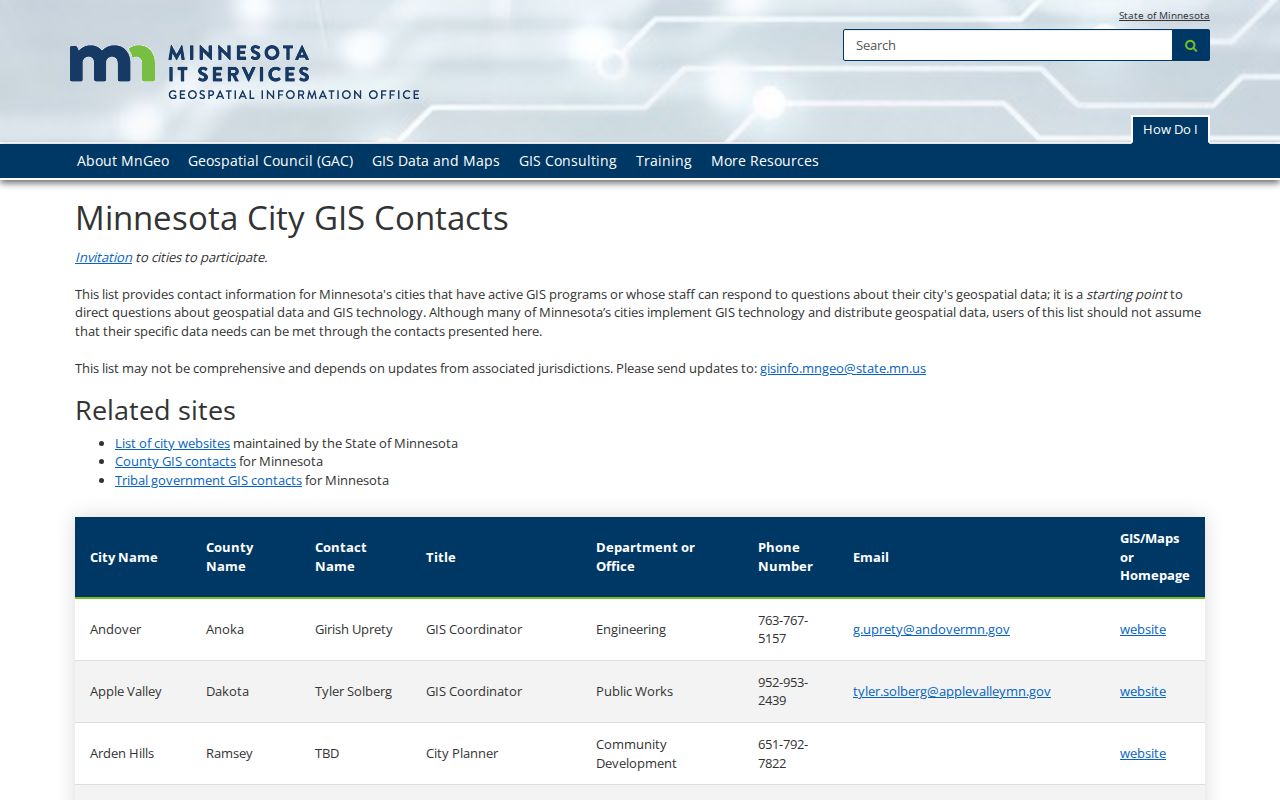
The directory entry here is a civic-contact source. It is not a public case search and not a court result.
Before visiting or counting on posted office hours, double-check the directory details against a current official source. That caution is about a small city's changing civic information, nothing more. The court route itself stays steady. Identify the Ogilvie matter. Choose the Kanabec location in MCRO, and call Court Administration when the file or the current calendar needs confirming.
Ogilvie Municipal Court Basics
No separate Ogilvie Municipal Court exists, and no city docket page should be assumed. Ogilvie's municipal records cover ordinances, meeting materials, and administrative communications. Any filed criminal, traffic, civil, family, probate, juvenile, or Conciliation Court matter sits in Minnesota District Court, Kanabec County. That court sits inside the Tenth Judicial District.
That division does not make city material useless. An ordinance can explain the local rule behind an Ogilvie dispute. It cannot tell you whether a case was filed or a hearing happened. It also cannot say what a judge ordered. Those answers come from the court case number and the Register of Actions. For the municipal side, use the city source. Confirm current Ogilvie office details instead of assuming walk-in service.
Ogilvie Clerk and Court Record Roles
The Ogilvie city clerk and Kanabec Court Administration do different jobs. The clerk's office deals with municipal business. Court Administration, by contrast, receives filings, maintains local court-file access, manages calendars, supports the courthouse terminal, and handles copy requests. The court names Heather Mickelson as Court Administrator. No separate elected county clerk of court is listed.
For an Ogilvie court question, the published Court Administration location is 317 Maple Avenue East, Suite 318, Mora, MN 55051. The phone is 320-679-6400. The Kanabec court contact route suits general questions, not emergency filings or a substitute for a specific record request. Have the Ogilvie case number, party or title, document, and date ready when you can.
Court Dates and Settings in Ogilvie
An Ogilvie hearing shows up through MCRO Hearing Search, Case Details, or the official Kanabec daily calendar, never through a city calendar dressed up as a court docket. The daily calendar posts at 7:00 a.m. on business days and gets hourly updates. It is still incomplete. Confidential or non-remote cases may be left off. For the most current case-specific confirmation on an Ogilvie matter, the courthouse displays come first. So does Court Administration.
| Date | The scheduled Ogilvie-area court setting, not a statement of outcome. |
|---|---|
| Time | The calendar time, which is not a guarantee of actual start or finish. |
| Courtroom | The listed room for the Ogilvie case, subject to a later change. |
| Judicial officer | The officer assigned to the Ogilvie setting, which can differ later. |
| Setting type | The procedural label; use later case events or an order for the result. |
Ogilvie MCRO Court Location Search
Filter by county first. In MCRO, the Court Locations control is the working county filter for an Ogilvie docket search: choose Kanabec under K, and only then narrow by filed date, status, or case category if it helps you pin down the right record. Category is not an outcome. Before trusting a result, open Case Details and read the title, filing date, court location, judicial officer, and status.
Not every MCRO screen does the same job for an Ogilvie court records hunt. Case Search runs on a name, case number, citation number, or attorney. Document Search needs a complete case number. Hearing Search takes a date and hearing type before linking to case details, while Judgment Search works from a debtor name and docketed date. Match the tool to the record you want instead of treating the search screens as interchangeable.
Traffic Tickets in Ogilvie
Start with numbers. For an Ogilvie traffic ticket, MCRO works best with the complete citation number or court case number when you have one. A public case can display the citation, the charge, hearing dates, a plea or payment, the disposition, and any financial event. All of it stays subject to access rules. The statewide traffic payment guidance lays out the route for payable matters. If the citation requires an appearance, follow the court instructions. Being issued in Ogilvie does not make it payable.
A listed charge or hearing date is not the outcome. Check the disposition or public order before drawing conclusions. A CR-prefixed case cannot be paid in place of appearing. And remember that the Minnesota court record is separate from a DPS driver-compliance record. The Ogilvie docket will not answer administrative driving questions.
Ogilvie Court Terminal and Mail Access
When remote MCRO cannot reach an Ogilvie record, the Kanabec courthouse offers a broader route. The MNPAC terminal there is a public hallway computer, not a separate website. It can show eligible material that remote rules limit. Court Administration can walk you through the local paper-file and copy process. The courthouse keeps Monday through Friday hours, 8:00 a.m. to 4:30 p.m. Visitors should budget time for security screening.
Mail works when a trip to the courthouse is impractical. Write to Kanabec Court Administration with the case number, parties or title, the document you want, a return address, a daytime phone, and payment if a fee applies. Per the Tenth District records guidance, a mailed copy request may take about five days. The statewide copy form offers plain-copy mail delivery and other options. Certified delivery goes through the local court office.
Name the product in your Ogilvie request. A Register of Actions is the chronological view of case activity. A public document is its own item, identified by description, date, or index number. A certified copy carries court authentication. Staff can explain the route. But a specific request lets them locate the right public record without guessing from a city name.
Where Ogilvie Cases Go
Ogilvie matters that become Minnesota court cases land in one place: Minnesota District Court, Kanabec County, in the Tenth Judicial District. One trial-court record serves the whole county. It covers criminal, traffic, civil, family, probate, juvenile, and Conciliation Court matters. Knowing the city helps with factual context. It does not create an Ogilvie court database. What identifies the file is the case number, court location, case category, and Register of Actions.
Docket flow: Ogilvie municipal records › Kanabec County Court Administration › Minnesota District Court, Kanabec County (Tenth Judicial District)
Conciliation Court is a division of that District Court, not a separate Ogilvie docket. Appeals move into the Minnesota appellate system, not to a city site. The countywide setup gives a small Ogilvie community one local trial-court records route, with no municipal court office to track down.
Ogilvie Federal Court Record Boundary
Federal records live elsewhere. A federal civil or criminal matter belongs to the U.S. District Court for the District of Minnesota. Federal bankruptcy goes to the U.S. Bankruptcy Court for Minnesota. Do not turn to federal portals for a Minnesota state Ogilvie citation or court file. State and federal court keep separate dockets, clerks, rules, and certification routes.
The District of Minnesota CM/ECF court information page identifies the federal filing and docket system. That system sets this record boundary for Ogilvie cases.
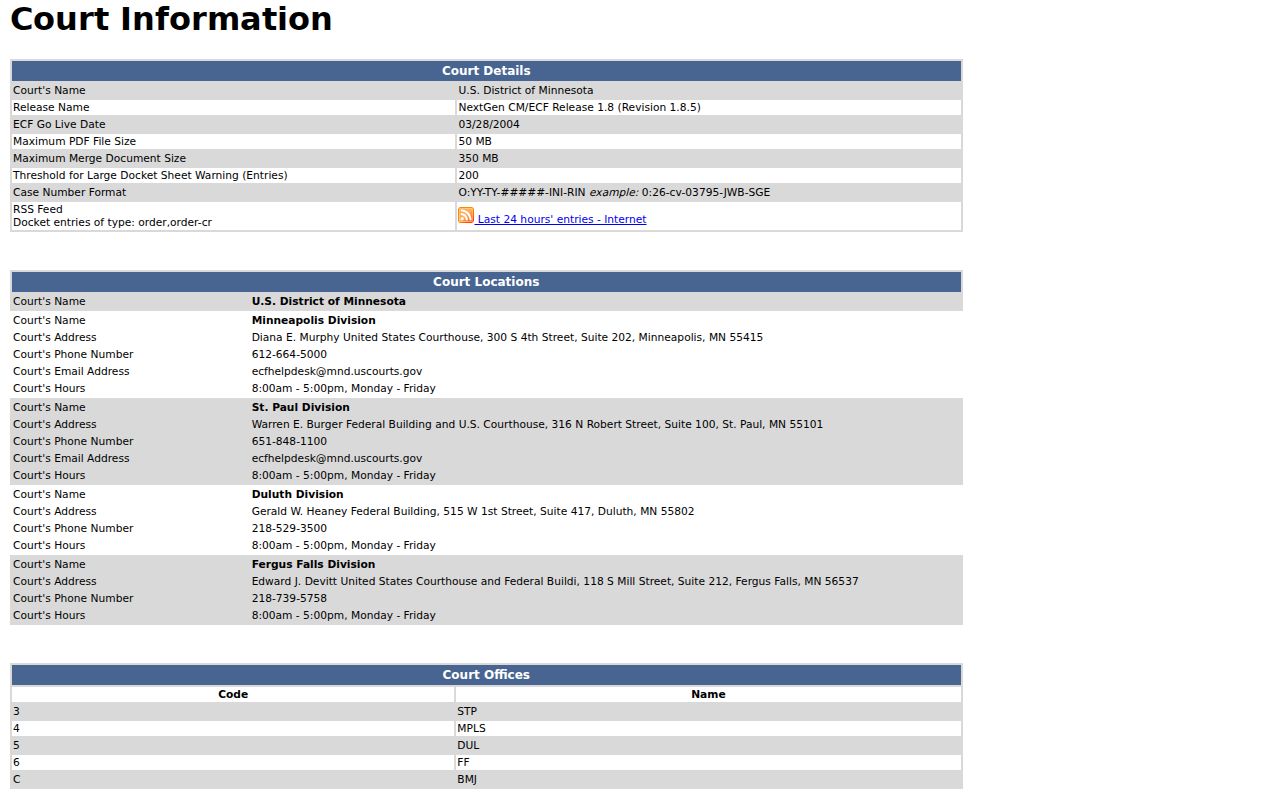
Here the contrast is the point. This view separates the federal docket system from the Minnesota District Court Register of Actions that holds an Ogilvie case. PACER’s official pricing information explains the federal public-access account behind the separate view.
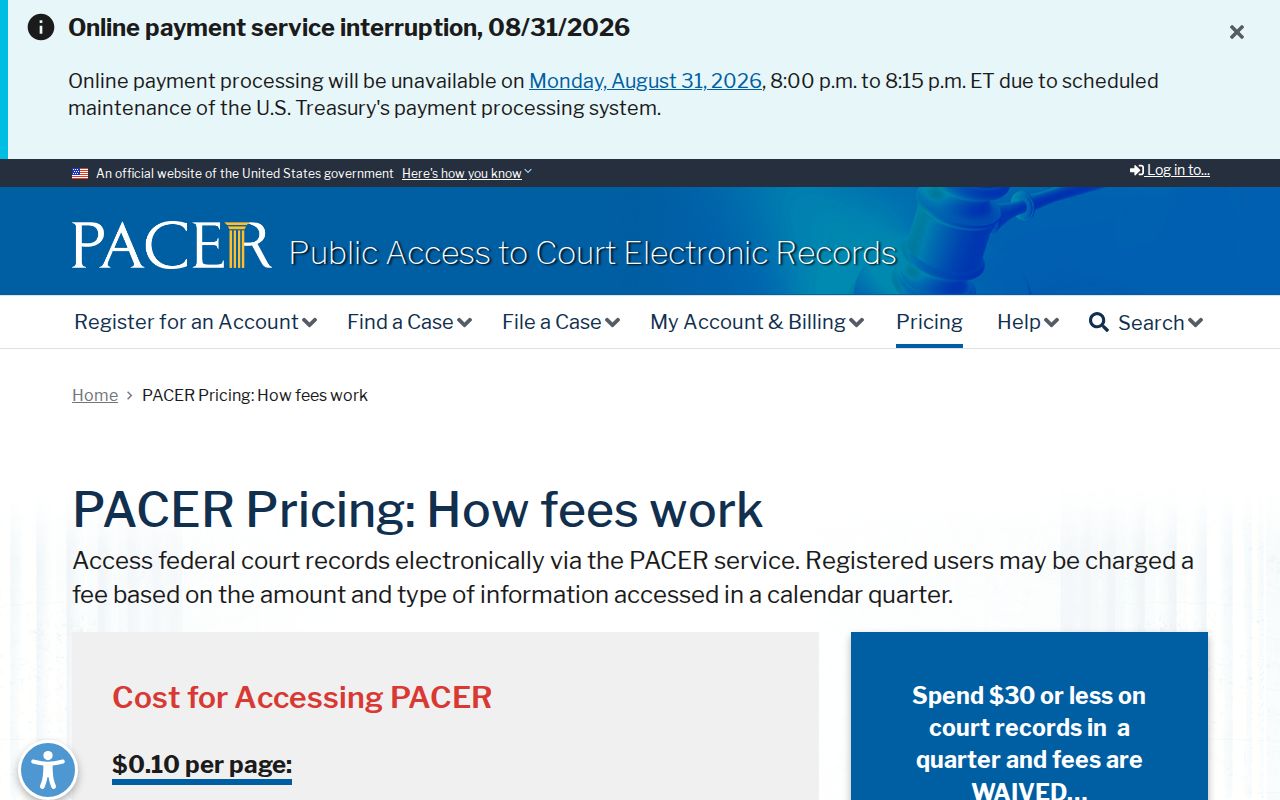
PACER matters only for a federal case. It is not an Ogilvie municipal docket, and it is no substitute for MCRO.
Ogilvie Court Record Access Rules
Access rules come from the Minnesota Rules of Public Access in the Minnesota State Courts. Public access has limits. Not every Ogilvie document is remote or unrestricted. Sealed, confidential, juvenile, domestic-abuse, harassment, CHIPS, commitment, and protected-identifier material can stay off limits. A court event appearing on the docket does not make the attachment public.
Ogilvie access rule: Minnesota’s court public-access rules govern the Kanabec court file and remote-access tiers.
Minnesota Statutes section 13.03 is general public-data background; court-specific access rules control the Ogilvie court record.
Ogilvie Court Copies and Limits
MCRO costs nothing for eligible remote documents. Even so, a remote Ogilvie result is not a certified record. For plain, certified, or exemplified copies, go through Court Administration and its statewide copy-request form. The fees are set out plainly: plain copies carry no fee. A certified raised-seal copy runs $14 per document. A certified plus exemplified copy runs $28. One caution is worth knowing. Pulling a staple out of a certified multi-page document strips away its certification.
A remote search that turns up nothing has several possible explanations. The record may be old. It may be only partly digitized or restricted by classification. It may simply not be eligible for remote display. That empty result is not a finding that no case exists. Court Administration can tell you which public channel is lawful and open. Parties can file or serve through Minnesota eFile and eServe. But eFS is not a public Ogilvie docket search.
The form is not an automatic key to protected or confidential material. A nonparty may need an administrative file number. Authorized-party documentation may be required. The court may demand an order or a separate access form instead. Fax and email delivery work only for plain, nonconfidential copies. Before sending anything sensitive, ask the local office which lawful route applies.
Older Ogilvie records raise one more question. Ask whether the public file sits locally. It may sit at a records center instead. It may even use another case-number format. A history or city source adds context, but it never replaces the official court file.